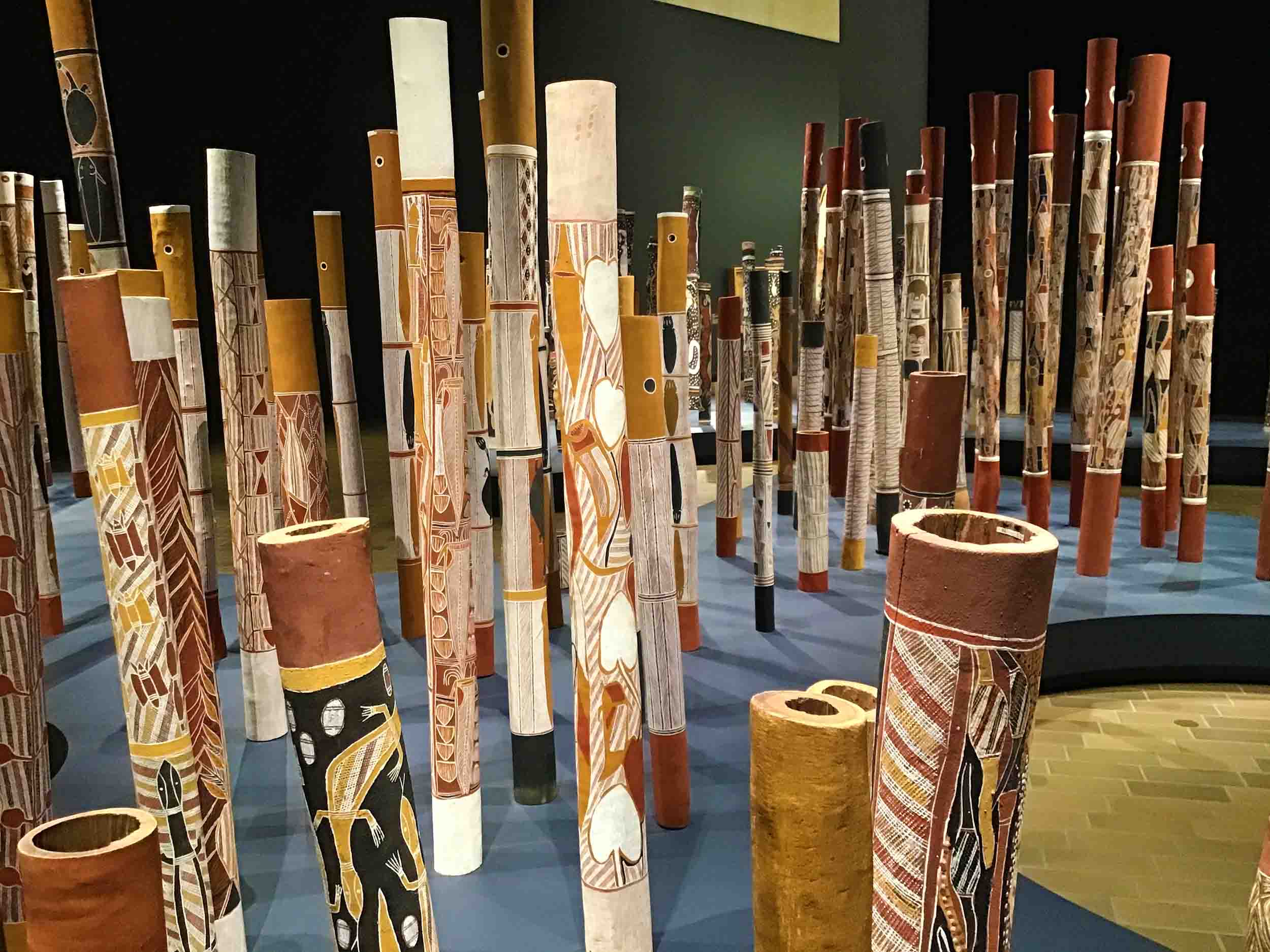
A few weeks ago I spent some days based in Canberra – I hadn’t been there for years. One day I walked from my central-city hostel along to the National Gallery. I didn’t have anything particular in mind – I like portraits, and I’m intrigued by what can be learned from some of the oldest landscape images (think ecology, and lost forests). But what I saw just inside the entrance, really blew me away – it looked like a forest of Aboriginal art.
The ‘trees’, 200 of them, are ‘hollow log coffins’, forming the ‘Aboriginal Memorial’. The installation was commissioned in 1988, and made by artists of the Ramingining community. That’s in Arnhem Land, about 560 kilometres east of Darwin, on the edge of the Arafura Swamp.
The coffins represent Indigenous people who have been killed, defending their land, since 1788. The different styles they have been painted in, reflect the artists’ social groups (or ‘clans’), and where they come from in the landscape – like ‘mangrove people’, ‘forest people’, or ‘beach people’. You can walk a path through the coffins – it broadly reprsents a river, the changing ecology to either side, and thus the social groups.
What immediately struck me – was what an amazing way to express identity, and resilience! However, I’m not an Indigenous Australian (or even Australian), my ancestry goes back to cold European swamps, not tropical Australian ones. I can admire this art, I can be educated by it, but there will always be a sense where I can’t totally relate to it – I am one of the Settlers/Colonisers/Invaders.
However, I would have had ancestors who would have gone through similar ‘events’ – invasion, colonisation, loss of identity. I wondered how European tribes – my ancestors, might have responded, artistically, to ‘Romanisation’, or to an even earlier, potential genocide, by the Yamnaya culture around 4,500 years ago. What kind of art might they have chosen, to place in a gallery, given a similar opportunity?
The ‘Aboriginal Memorial’ is a wonderful piece of art, an effective way of publicising what has happened to Indigenous Australians, but it also provoked thoughts about my own identity.
In short, I found inspirational.
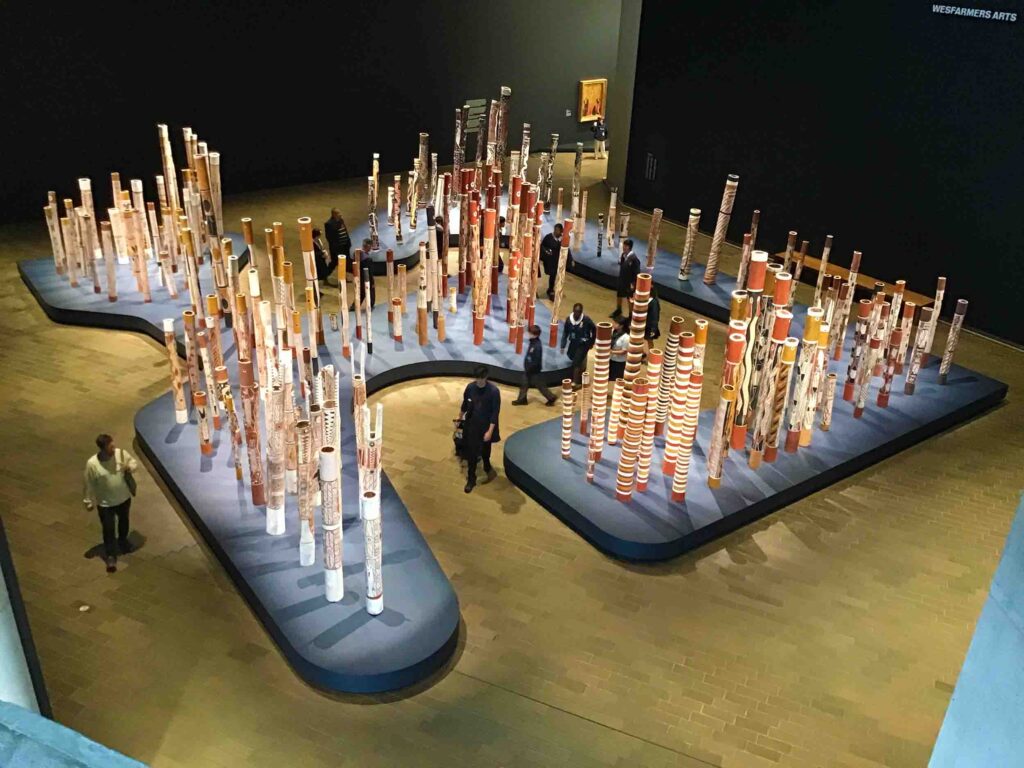
This view of the Aboriginal Memorial (National Gallery, Canberra) from above gives a better indication of scale than the header image. It shows the ‘path’ or ‘river’ through the middle. Photo: the author (Mike Pole).
Links
The ‘Aboriginal Memorial’
Wikipedia: Ramingining, Northern Territory